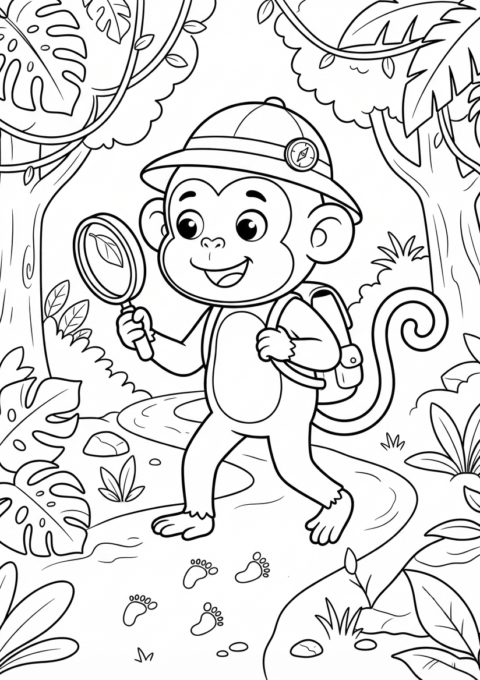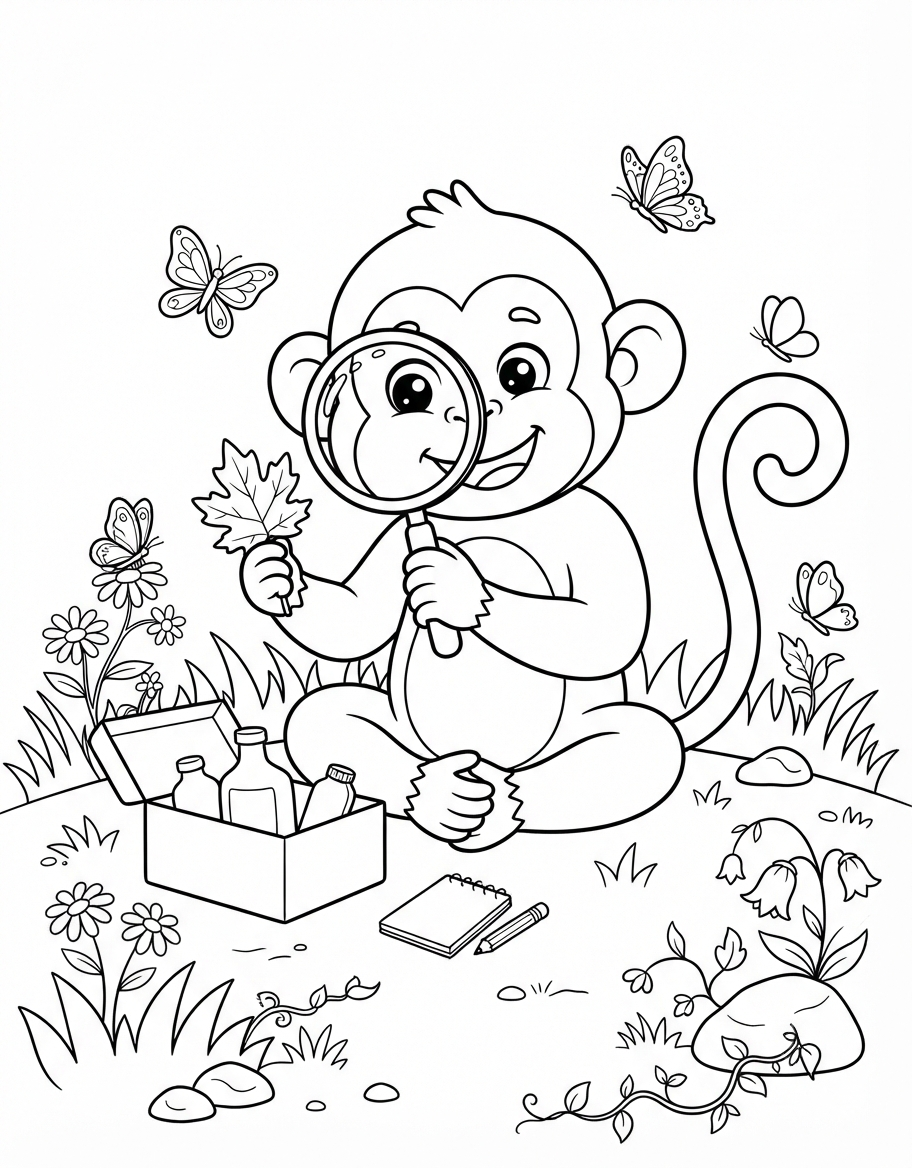

This little monkey has traded jungle play for nature study, sitting cross-legged with a magnifying glass held up to examine a leaf. Nearby sits a small collection box with jars, a notebook, and a pencil — the gear of a young naturalist — while butterflies flutter through the flowers and grass around it.
A Monkey Turned Nature Explorer
Rather than swinging through trees or eating bananas, this monkey is doing something a lot of curious kids do outside: stopping to look closely at something small, like a leaf, and really study it. The magnifying glass, notebook, and little specimen jars all suggest careful, patient observation rather than quick play.
What’s Scattered Around the Scene
- A magnifying glass held up to a leaf
- A small collection box with a few jars inside
- A notebook and pencil, ready for notes
- Several butterflies fluttering nearby
- Flowers, grass, and a couple of rocks filling out the ground
Coloring Ideas
- The monkey can be a classic brown or tan, or any color your child prefers for their explorer character.
- Butterflies are a great spot for bright, varied colors — no two need to match.
- The leaf being examined can be colored a realistic green, or something more imaginative since it’s the focus of such close attention.
- The little jars in the collection box can each be a different color, as if they hold different specimens.
A Gentle Nudge Toward Curiosity
This page works well as an invitation to look closely at the natural world — leaves, bugs, flowers — the same way the monkey is doing here. It doesn’t require any real science knowledge to enjoy; the idea is simply that looking closely at ordinary things can turn up something interesting.
Questions to Ask
- “What do you think the monkey notices about the leaf up close?”
- “What would you want to look at with a magnifying glass?”
- “How many butterflies can you count in this picture?”
Ways to Use This Page
At home, it pairs nicely with a real backyard nature walk — bring an actual magnifying glass and notebook and look for leaves, bugs, or flowers to examine. In a classroom, it fits naturally into a nature-study or observation-skills lesson.
Printing Tips
Print at 100% scale rather than “fit to page” to keep the smaller details, like the butterflies and jars, sharp.
Related Coloring Pages
Browse more from our Monkey coloring pages collection, or try School Science Experiment for another observation-themed page.
Frequently Asked Questions
What age is this coloring page suitable for?
Roughly ages 4 to 9 — the small background details give older kids plenty to work with, while the main character stays simple enough for younger ones.
Is this a real kind of monkey?
No — it’s a friendly, general cartoon monkey rather than a specific species.
Can this page be used for a nature or science lesson?
Yes — it pairs well with an actual outdoor observation activity, like examining leaves or insects with a real magnifying glass.