Coloring Page
School Science Experiment Coloring Page
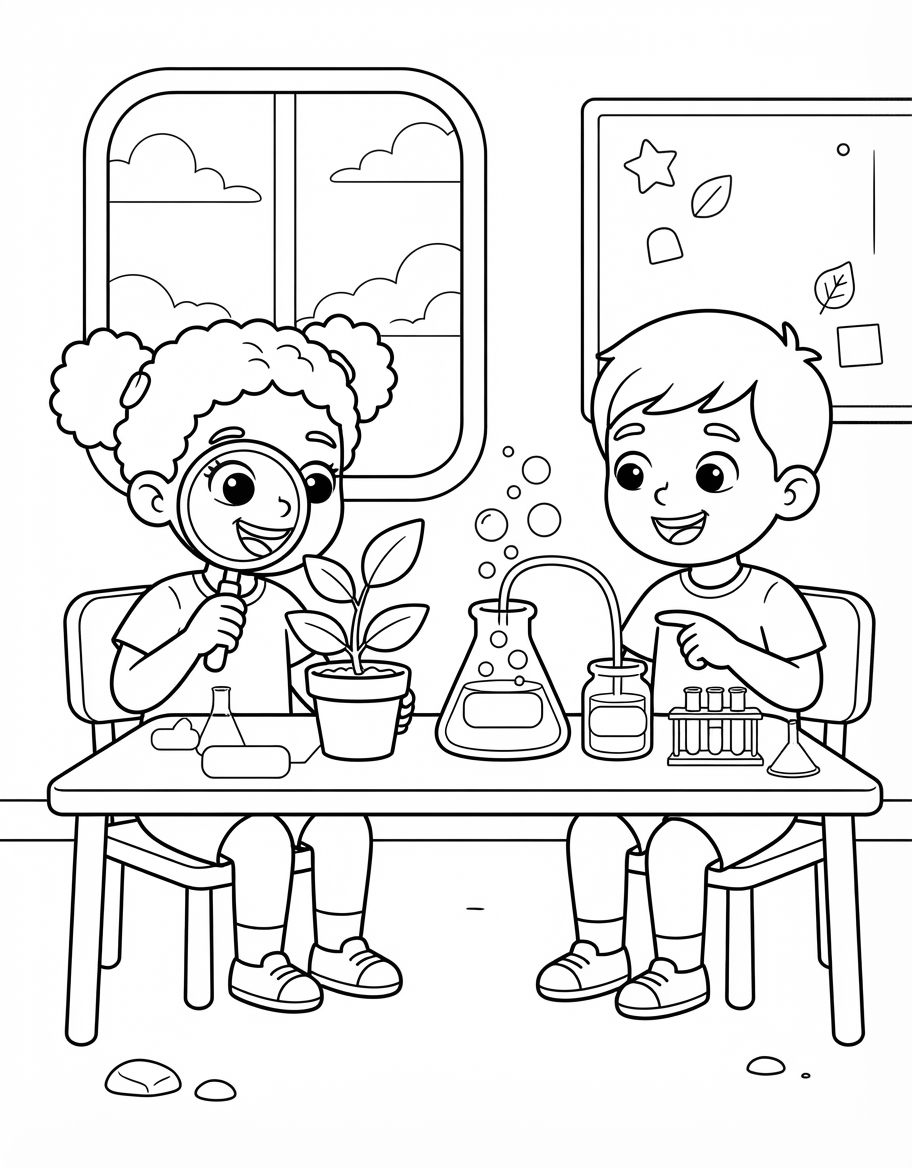
Free printable school science coloring page with kids observing a plant through a magnifying glass and watching a bubbling flask experiment.
A girl peers through a magnifying glass at a small potted plant, while across the table a boy points excitedly at a bubbling flask connected by a tube to a jar, with a rack of test tubes nearby. A bulletin board with a star and leaf shapes hangs on the wall behind them — this is a classroom clearly set up for hands-on science.
Two Different Kinds of Investigating
The two kids in this picture are doing two different things, which makes it a nice page for talking about the many ways scientists observe the world. The girl is using a magnifying glass to look closely at a plant — a simple, quiet kind of observation. The boy is watching a bubbling flask connected to a jar by a tube, with a rack of test tubes lined up nearby — a more active, “something is happening” kind of experiment.
Naming the Science Tools
- A magnifying glass, for looking closely at small details
- A potted plant, something living to observe and study
- A flask with bubbles rising inside it
- A row of test tubes in a rack
- A small glass vial off to the side
None of these need a real chemistry lesson to talk about — simply naming each tool and asking what a child thinks it’s for is enough to make the page feel educational without turning it into homework.
Coloring Ideas
- Lab equipment like flasks and test tubes look great in classic science-lab colors — clear glass with colorful liquid inside, like blue, green, or purple.
- The plant is a good spot for realistic greens, or a child can invent their own imaginative plant color.
- The bulletin board shapes (star, leaf) can be bright and varied, since they’re decorative rather than part of the experiment itself.
- Bubbles rising from the flask can be left white/uncolored or given a very light blue outline for a bit of shimmer.
A Gentle Introduction to Curiosity and Observation
This page leans naturally into the idea that science starts with noticing things — looking closely, asking questions, and watching what happens. Rather than explaining any specific experiment, it’s more useful as a jumping-off point for a child’s own questions: What do you think is in that jar? Why do you think there are bubbles?
Questions to Ask
- “What do you think the girl notices when she looks at the plant up close?”
- “Why do you think bubbles are coming out of the flask?”
- “If you could investigate anything with a magnifying glass, what would you look at?”
Ways to Use This Page
At home, it pairs well with an actual simple observation activity — looking at a leaf, a bug, or a houseplant with a real magnifying glass. In a classroom, it’s a natural fit for a science unit, especially one involving plants or basic lab tools.
Printing Tips
Print at 100% scale rather than “fit to page” so the smaller lab equipment, like the test tubes, keeps its detail.
Related Coloring Pages
Try School Art Class for another hands-on classroom activity, or School Library for a quieter subject page — both part of the Back to School coloring pages collection.
Frequently Asked Questions
What age is this coloring page suitable for?
Roughly ages 5 to 10 — the lab equipment and multiple small details make it a slightly more involved page than some other back-to-school pages.
Do I need to explain a real experiment to use this page?
Not at all — it works just as well as an open-ended “what do you think is happening” conversation as it does with a real science lesson.
Is this a good page for a science unit?
Yes — it pairs especially well with lessons on plants, observation, or introducing basic lab tools.